
Tertiary education: Charters important but shouldn't be compulsory, says President Mahama
Education
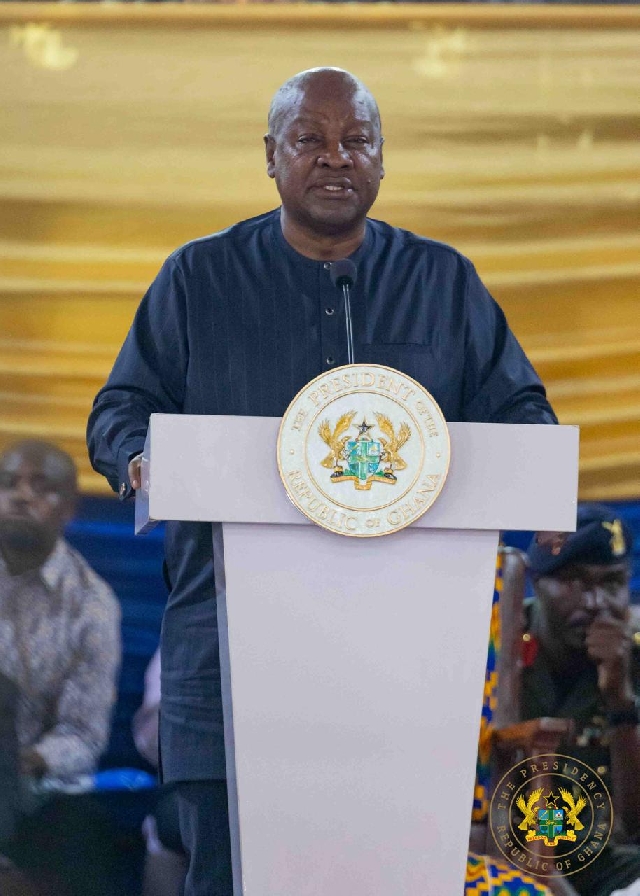 President JD Mahama
President John Dramani Mahama and stakeholders in tertiary education have called for flexibility in the chartering of private universities, stressing that while charters are important, they should not be compulsory.
Speaking at a stakeholder engagement, President Mahama recalled that Ghana once had only three public universities; University of Ghana (UG), University of Cape Coast (UCC), and Kwame Nkrumah University of Science & Technology (KNUST), severely limiting access to tertiary education. He said successive governments have since expanded public universities and converted polytechnics into technical universities, but demand continued to outstrip government capacity.
The President said this led to the opening up of the space for private universities from 1998, adding that private institutions have played a crucial role in complementing government efforts. He described their contribution as significant in expanding access to higher education.
President Mahama noted that he signed the first-ever charter for a private university, Central University College, during his first term in office. He explained that the issue of compulsory chartering recently came up strongly in Cabinet, which agreed that more time should be given to institutions, including the option of a moratorium.
He welcomed the position of the Ghana Tertiary Education Commission (GTEC) in supporting optional chartering but stressed that making it optional would require amending the law and securing approval from Parliament.
The president also clarified that comments he made earlier on the issue had been misinterpreted, explaining that he was responding to concerns raised by a student about private universities operating under perpetual affiliation. He said such student concerns must be considered, as future students may prefer chartered institutions over those without charters.
Meanwhile, the Secretary of the Private Universities Founders Association, Professor Martin Gyamrah, said he was convinced after discussions that charters should be optional and not imposed as a form of punishment.
Professor Gyamrah said every institution aspires to grow into a full-fledged university, but warned that if chartering becomes optional, the accreditation of academic programmes must be stricter to ensure quality and value for money, especially given the high fees paid by students.
He also used the platform to draw attention to the Encyclopedia Africana project, originally initiated by Dr Kwame Nkrumah. He said the African Union has adopted the project and approved the production of a fourth volume focusing on the contributions of Africans and the diaspora to scientific development.
Professor Gyamrah disclosed that he has been elected Chair of the Scientific Committee to produce the fourth volume, with Ghana playing a leading role. He appealed for government support to ensure the project is completed, describing it as a major achievement that would bring honour to the country.
Source: classfmonline.com/Pearl Ollennu


Trending News
GNFS officers interdicted following Kasoa journalist assault- Mahama reveals
13:31
NPA Chief Executive welcomes staff back to work, reaffirms commitment to welfare and service delivery
11:46
Dombo’s house speaks: Northern power brokers rally behind Bryan Acheampong
12:56
Stalled road projects reactivated as Ghana nears completion of debt restructuring – Roads Minister
11:07
DVLA warns motorists against incomplete vehicle ownership transfers
02:22
La-Dade Kotopon Constituency MP spreads joy with 2025 Christmas celebration
13:54
We're determined to prevent plate duplication-DVLA
11:34
Fanteakwa South NDC executives hold thanksgiving service with SDA Church
12:48
Agotime Ziope MP calls for automatic inclusion of vulnerable widows in LEAP programme as he donates to support over 500 widows in Agortime Ziope
11:54
January 9 declared Public Holiday to mark Constitution Day
02:15