

GEXIM faces GHS1.5bn credit exposure as NPLs near 30% — CEO
Business
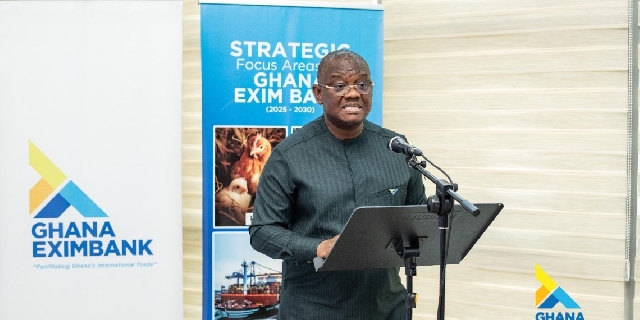 Slyvester Mensah
The Chief Executive Officer of the Ghana Export–Import Bank (GEXIM), Sylvester Adinam Mensah, has revealed that the Bank is contending with a total credit exposure of about GHS1.5 billion, nearly 30 per cent of which is currently classified as Non-Performing Loans (NPLs), a situation he says poses significant risks to the institution’s balance sheet, reputation and long-term sustainability if not urgently addressed.
Mr. Mensah disclosed this at an end-of-year media engagement in Accra, clarifying that the exposure should not be interpreted as losses already incurred.
Rather, he explained, it represents credit facilities extended to clients across strategic sectors of the economy, some of which have stalled due to governance weaknesses, poorly timed disbursements, incomplete project execution and, in certain cases, borrowers’ refusal to honour repayment obligations.
While acknowledging the challenge, the GEXIM CEO said the scale of the NPLs has underscored the need for a comprehensive reset of the Bank’s lending philosophy, risk management framework and recovery mechanisms.
He noted that GEXIM’s NPL ratio—estimated at just under 30 per cent—is higher than the industry average of about 21 to 22 per cent for commercial banks, but argued that such comparisons must be properly contextualised.
According to him, as a development finance institution, GEXIM deliberately operates in high-risk segments, providing long-term, patient capital to sectors such as agriculture, agro-processing and export-oriented manufacturing, which commercial banks are often reluctant to finance.
Nonetheless, Mr. Mensah cautioned that elevated NPLs constrain the Bank’s ability to recycle capital, weaken its capacity to support new projects, increase provisioning pressures and threaten its credibility as a custodian of public development finance.
Left unaddressed, he warned, the situation could erode confidence among policymakers, international partners and private sector clients.
Against this backdrop, he announced a strategic realignment of GEXIM’s loan portfolio, with a policy decision to channel at least 70 per cent of future lending into priority value chains—particularly poultry, rice and other productive sectors—while the remaining 30 per cent will support complementary activities that stabilise the broader economy.
He said future lending decisions will be strictly guided by data, sector studies and international benchmarks.
As part of this data-driven approach, Mr. Mensah disclosed that the Bank has undertaken study visits to Côte d’Ivoire to examine how deliberate policy and financing choices transformed that country’s domestic poultry industry. He cited strict regulations that prohibit the importation of dead or frozen chicken as a key driver of increased local production and reduced import dependence, adding that similar outcomes are achievable in Ghana if financing aligns with supportive policies and market realities.
He also referenced technical studies conducted in Italy and other countries, which have informed GEXIM’s strategy to address recurring gluts in Ghana’s poultry sector. To tackle the imbalance between unmet domestic demand and periodic oversupply, the Bank is supporting value-addition initiatives such as liquid egg processing for export markets, aimed at stabilising prices, reducing waste and improving foreign exchange inflows.
Mr. Mensah admitted that some of the NPL challenges stem from structural weaknesses in how certain facilities were previously designed and disbursed. In some cases, he said, clients received only partial funding for projects intended to cover infrastructure, equipment and working capital, resulting in incomplete execution and repayment obligations commencing before projects became viable.
He said these governance gaps have now been identified and addressed, with partially disbursed facilities being restructured and stricter rules enforced to ensure projects are fully funded, properly sequenced and aligned with realistic cash-flow timelines before repayment begins.
On recovery, the GEXIM CEO said the Bank has adopted a tougher stance, with several delinquent borrowers already referred to the Economic and Organised Crime Office (EOCO) and the Attorney-General’s Department. “The era of treating Exim Bank loans as free money is over,” he warned, adding that deliberate defaulters will face decisive recovery actions.
He further noted that where evidence emerges of internal staff breaching procedures or improperly waiving conditions precedent to disbursement, such cases will also be investigated and accountability enforced.
Beyond recovery efforts, Mr. Mensah said GEXIM is implementing a five-year strategic plan to strengthen institutional resilience, including organisational restructuring, enhanced internal controls and the establishment of a sustainability and strategic impact department to ensure value for money and compliance with environmental, social and governance standards.
Despite the challenges, he expressed confidence that the reset agenda will restore the Bank’s financial health and developmental relevance, arguing that disciplined lending and decisive action on NPLs will strengthen GEXIM’s balance sheet and credibility.
He added that the reforms will support Ghana’s broader economic objectives by reducing dependence on imported rice and poultry, boosting exports, supporting small and medium-sized enterprises, improving foreign exchange inflows and enhancing food security.
Mr. Mensah concluded that how effectively GEXIM manages its GH₵1.5 billion exposure and reins in non-performing loans will be critical to the Bank’s sustainability and its ability to deliver on its mandate to drive Ghana’s industrial and agricultural transformation.
Source: Classfmonline.com/Cecil Mensah


Trending News

Vice President pays a working visit to Ministry of Fisheries and Aquaculture
07:11
Accra high court bars journalist from publishing allegations against private individual
12:00
Surveyors’ Bill to strengthen regulation and professional standards in land use
13:28
Gov't to introduce awards scheme for cleanest regions, districts: President Mahama announces
13:47
Ghana chamber of mines urges government to pause mining royalty reforms
12:50
Forestry Commission seizes 3,967 dried shark fins
08:03
AG to prosecute Wontumi Farms, directors over GHS24m EXIM Bank fraud
11:54
Police investigate alleged murder of woman in Juaboso district
13:22
GA/R: Residents of Chorkor raise alarm over deteriorating bridge linking Chemuenaa
12:43
Soldiers deployed to Jamaica: Ghana committed to int'l humanitarian service - President Mahama
18:52