
Experts say urgent action needed on anti-microbial resistance threat
Health News
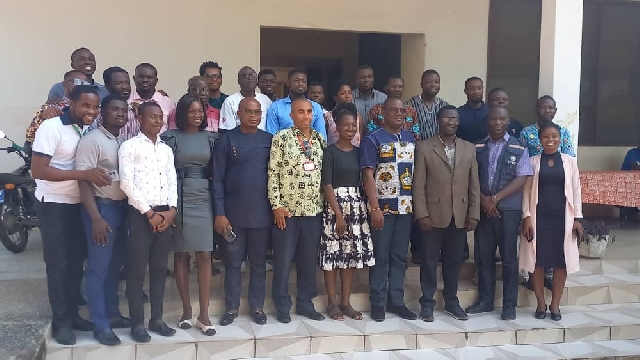 Participants at the workshop
Prof Kwame Ohene Buabeng, the Dean of the School of Pharmacy at the University of Health and Allied Sciences (UHAS) in the Volta Region, has emphasised the severity of Anti-microbial Resistance (AMR) as a significant public health threat, requiring immediate attention from all stakeholders.
Prof Buabeng, a Clinical Pharmacologist, stressed that AMR poses a global public health threat, as declared by the World Health Organization (WHO), and is silently becoming a pandemic, making it increasingly challenging to treat infections in many health facilities.
Speaking during a two-day training workshop in Ho for media professionals in the Volta Region on Anti-microbial Resistance (AMR), Prof Buabeng explained that the situation has reached a point where health professionals struggle to treat infections with antibiotics, and the problem is projected to cause about 10 million deaths by 2050.
Mr Godfred Saviour K. Azaglo, a Senior Policy Officer at the Environmental Protection Agency (EPA) Head Office, emphasized the importance of environmental care in reducing AMR.
He highlighted that AMR is present in the air, industrial wastewater, municipal wastewater, soil, and vegetables, emphasising the need for conscious efforts to reduce it.
Mr Azaglo recommended adherence to health protocols, including handwashing, to mitigate the risks associated with AMR.
Dr George K. Hedidor of the World Health Organisation (WHO) discussed the Global Action Plan (GAP) endorsed at the sixty-eighth World Health Assembly in 2015 to address the growing problem of anti-microbial resistance.
He noted that Ghana has developed and launched a National AMR Action Plan (NAP) aligned with the GAP and the Food and Agricultural Organisation (FAO) AMR Action Plan.
The Communication Officer of the Food Agriculture Organisation, Mr David Young emphasized the role of the media in raising awareness about AMR and the importance of the World Anti-microbial Awareness Week (WAAW), observed in November every year.
The WAAW 2023 campaign focuses on preventing anti-microbial resistance, calling on stakeholders to recognise their role in being AMR awareness champions.
The experts stressed the urgency of collective efforts to combat AMR, including environmental care, adherence to health protocols, and awareness campaigns through media advocacy.
The media was identified as having a crucial role in fostering policy and social change to address the challenges associated with AMR.
Source: Classfmonline.com/Cecil Mensah


Trending News

Health Minister receives report on Zipline Medical Drone Service
16:59
No apology, but diplomacy: Israel pushes back on Ghana claim
20:43
3 candidates in the race as EC schedules Kpandai rerun for Dec 30
19:57
Adu-Boahene case: Atta Akyea exposes inconsistencies in A-G witness’s EOCO testimony
06:45
Amasaman MP marks one-year anniversary of election victory, pledges accelerated development
06:46
NDC Legal Director thanks God for party’s election victory
03:36
Majority Leader withdraws Special Prosecutor repeal Bill after President Mahama’s appeal
16:34
VP Opoku-Agyemang eyes English-teaching opportunities in Colombia as language, cultural ties grow
11:26
Ghana deports 3 Israelis in retaliation, gov'ts commit to resolution
19:29
CID, BoG arrest 41 in Accra crackdown on illegal forex trading
22:25