

Moses Baiden:Commends NIA Margins Group partnership over Ghanacard
Technology
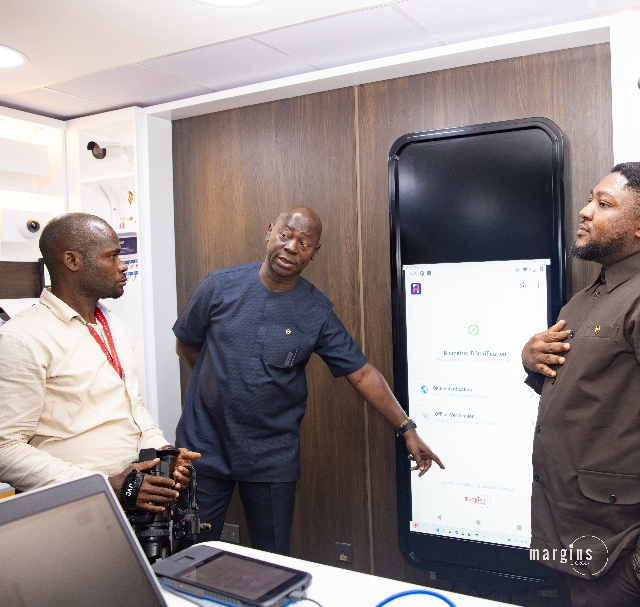 Moses Baiden doing verification on Ghanacard
The Ghanacard has become the most visible product associated with Margins Group, but its founder and Chief Executive Officer, Mr. Moses Kwesi Baiden Jr., is quick to stress that the achievement is rooted in partnership, not ownership.
“The National Identification Authority (NIA) is our partner. We support them; we do not replace them,” Mr. Baiden said.
That partnership has delivered striking results.
Ghana has registered about 90 per cent of its adult population, placing the country among the most advanced national identity systems in the developing world.
In a single year, 15.7 million people were registered, with card production capacity reaching as high as 250,000 cards per day.
Recalling visits to remote communities, Mr. Baiden praised NIA officers who worked under extremely difficult conditions.
“It is not perfect,” he admitted, “but it is a fantastic job.”
For him, the success of the Ghanacard is as much about governance as it is about technology.
Sustained over more than 13 years, the NIA–Margins partnership, he noted, stands as one of Ghana’s most successful public-private collaborations, built on transparency, compliance, goodwill and national interest.
Ghana’s experience has drawn growing international interest.
Delegations from across Africa now regularly visit the country to study how national identity has been integrated into public services, making the Ghanacard a reference point for digital governance on the continent.
Margins’ contribution to Ghana’s digital infrastructure extends well beyond national identification.
The company built the Driver and Vehicle Licensing Authority (DVLA) system, linking every registered vehicle and driver to the Ghanacard while maintaining an independent platform.
This integration has significantly strengthened law enforcement and improved road safety.
Margins has also delivered the National Health Insurance claims management system, supported by a secure data warehouse designed to eliminate forged claims.
In addition, it has developed systems to identify and eliminate ghost names on public payrolls, which are awaiting deployment by the Controller and Accountant-General’s Department.
Notably, Margins built Ghana’s border control system, making it the only African company to have locally developed such a platform.
He touted the benefits of the NIA -Margins Group partnership at the launch of the company's 35th anniversary in Accra
“Many Ghanaians carry our products without knowing it,” Mr. Baiden revealed.
Margins manufactures Visa, Mastercard, UnionPay and European payment cards and provides personalisation systems used by banks, either in-branch or as managed services.
Today, Margins operates in eight countries, with offices in Portugal, Copenhagen, Silicon Valley and The Gambia.
The company is currently producing The Gambia’s national ID cards and finalising additional major contracts there.
This global footprint, Mr. Baiden explained, is the result of over three decades of methodical expansion, strategic partnerships and relentless reinvestment.
Despite its achievements, Mr. Baiden recalls moments that revealed deep-seated doubts about African industrial capability.
He recounted an early meeting in Accra during preparations to build what would become the first card production facility of its kind in sub-Saharan Africa.
While European stakeholders were enthusiastic, a government official raised a concern.
“She asked, ‘If we build this factory in Africa, would that not compromise security?’” he recalled.
For Mr. Baiden, the question exposed a mindset that remains one of the greatest obstacles to industrialisation.
“When soil is fertile, seeds grow naturally. When the soil is hard, nothing grows,” he said.
“We cannot industrialise or build wealth without building things.”
The irony of that doubt is that Margins itself began in extremely modest conditions.
In 1990, at the dawn of the ICT revolution, a young law student named Moses Baiden invested his entire savings—£3,500 earned from holiday work in London—into a Toshiba laptop.
“That was all the money I had,” he said. “But I believed computers were going to change the world.”
Although his father hoped he would become a lawyer, Mr. Baiden was determined to be a businessman.
He saw opportunity in the rapid replacement of typewriters with computers and asked a simple question: who would supply the tools to print, bind and preserve documents?
With just $100 and operating from the boys’ quarters at Ringway Estates, he founded Margins at the age of 24.
Within two years, the company had sold more than 1,000 laminators and binders across Accra.
By age 27, Margins was generating millions in revenue from consumables, driven by an intense focus on customer service.
Even in the early 1990s, the company ran a fully networked office with inventory, invoicing and warehouse management systems—what would later be known as customer relationship management.
As clients increasingly demanded services rather than machines, Margins evolved into print solutions and, eventually, identity production.
This required mastery of specialised materials, security features and manufacturing processes.
Mentorship played a critical role. Mr. Baiden credits his Danish partner, Peter Blom, as well as mentors such as Dr. Wolfensperger of Switzerland and Korean industrialist Young Pioung Kim, who introduced him to global systems thinking and security printing.
By 1997, Margins was laminating passports. When Ghana adopted hot-melt laminated passports without local expertise, Mr. Baiden travelled to Korea, worked overnight with engineers to modify machines, and returned to Ghana to demonstrate the solution—winning the contract.
From there, Margins expanded into bank cards, voter IDs, military and police IDs, airport systems and, ultimately, national identity platforms.
“We changed as digitisation changed the form factor,” Mr. Baiden said.
Early on, he recognised that secure identity systems would be central to Africa’s future.
With a projected population of 1.4 billion, the continent needed integrated platforms to connect people to services.
That vision led to partnerships with Danish and Brazilian firms and the establishment of Margins ID Systems Limited. Through innovation, grants and partnerships, the company built high-tech manufacturing and software capacity on African soil.
“A factory is not just machines,” Mr. Baiden said. “It is knowledge, systems and a market.”
After 35 years, Mr. Baiden remains clear-eyed about the cost of success. “I don’t believe in get-rich-quick schemes,” he said. “I’ve worked 12 to 14 hours a day for 35 years.”
He is equally emphatic about sharing credit, describing Margins as the product of an extraordinary team.
Much of the company’s software is written in Ghana by Ghanaian engineers working alongside global talent.
Chairman of the NIA Board, Mr. Moses Afetsi Positive, has publicly commended Margins for helping to build what he described as “a very good system.”
According to him, the Ghanacard has become one of the most effective tools for eliminating waste across public and private systems by making ghost names increasingly difficult to sustain.
He also highlighted the system’s growing importance in combating cyber fraud, noting that trusted identity is now the first line of defence in a digital economy.
The Executive Secretary of the NIA, Mr. Wisdom Yayra Koku Deku, has been even more candid, admitting that without the partnership with Margins, the Authority might not have survived its early challenges.
Initial operational and logistical gaps nearly derailed the programme, but sustained technical and systems support stabilised it.
Looking ahead, the NIA is preparing for a new phase under a revised legal framework.
Once the new Act is passed next year, the Authority will be more deeply integrated into Ghana’s security architecture, enabling law enforcement agencies to access defined information linked to the Ghanacard within strict legal safeguards.
Mr. Deku emphasised that the foundation for the Ghanaard was laid more than a decade ago, when a 2012 Legislative Instrument made it mandatory for transactions requiring identification.
What Margins and the NIA have since achieved, he said, is giving that law practical meaning at national scale.
With four subsidiaries—Margins ID Systems Applications Ltd, Intelligent Card Production Systems (ICPS), and Identity Management Systems (IMS I & II)—Margins ID Group today stands as a symbol of what sustained belief, partnership and hard work can achieve.
“If we put our minds to it,” Mr. Baiden said, “everything is possible.”
Source: Classfmonline.com/Cecil Mensah


Trending News

Nana Oye Bampoe-Addo at 60: A legacy of gender advocacy and inclusive leadership
15:43
Foreign Affairs Minister begins 2-day visit to Burkina Faso to deepen security, diplomatic ties
18:17
Security Bill flawed; centralises excessive power at the Presidency – Minority
08:23
Peter Yaw Kwakye-Ackah urges Ghanaians to prioritise local food production
14:32
B/R: Bono Police recover 5 firearms in shootout, 1 suspect killed
21:08
VADUG Chairman urges Trade Minister to improve engagement with vehicular industry
12:02
GFL Secretary General urges trade union leaders to align with NDC's socialist ideology
14:59
Police arrest 14, including National Security operatives, over demolition of buildings in Gomoa Akoti and Ojobi
13:46
Alban Bagbin: Political parties must lead gender empowerment push
18:05
Ghana’s High Commissioner to South Africa pays courtesy call on Asantehene in Sandton
08:19
