

UAE condemns Iran's 'brazen' attack on tankers as US launches fresh strikes
World News
 Strait of Hormuz
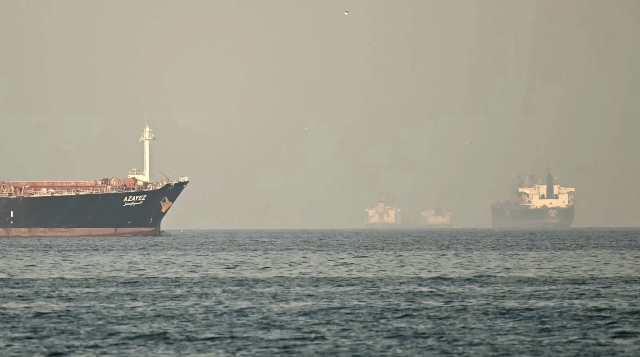
The UAE accused Iran of a "brazen" attack on two tankers in the Strait of Hormuz on Monday, killing one and wounding eight, as Donald Trump said the US would impose a 20% charge as part of a new blockade on the waterway.
The US president said they were hitting Iran "very hard" as strikes were launched for the third consecutive night amid escalating attacks between the two countries.
Iran's foreign minister responded to the announcement of a blockade by saying that Tehran would remain the Strait's "GUARDIAN" - using Trump's word.
The dispute over control of the Strait of Hormuz threatens to derail efforts to end their war, but Trump insisted a deal was still possible.
As tensions over the international waterway ramped up, the United Arab Emirates said on Monday night that Iranian cruise missiles targeted two national tankers, killing an Indian crew member and wounding eight others, four of which were serious.
Six of those injured were Indian, while two were Ukrainian, the UAE Ministry of Defence said in a statement on X.
"The Ministry of Defense condemns this brazen attack, which constitutes a serious violation and a clear breach of international law, threatening the security and stability of the region," it said.
Iran's Islamic Revolutionary Guard Corps (IRGC) later confirmed the strikes via a statement to Telegram, where it said two tankers had ignored warnings, turned off navigation systems and attempted to pass through a mined route.
In response, the IRGC said it had hit the tankers and disabled them.
It added that "co-operation with the aggressor enemy" would only lead to regret, damage and delays in opening the Strait - as well as the "creation of an energy crisis in the world".
The strait remains a key flashpoint between the US and Iran, with both sides clashing over the waterway's control on Monday after exchanging strikes in the region over Sunday night.
In a Truth Social post earlier in the day, Trump said the US was reinstating a naval blockade of Iranian ports and would impose a 20% charge on all cargo shipped through the Strait of Hormuz.
He said this would stop "Iran's ships or customers" from entering or leaving the key oil shipping route, but "all other countries will have fair and open use of the Strait". The blockade will be in effect from 16:00 Eastern Time (20:00 GMT) on Tuesday.
"The U.S.A. will be, from this point forward, known as "THE GUARDIAN OF THE HORMUZ STRAIT," but as such, and as a matter of FAIRNESS, will be reimbursed, at the rate of 20% on all cargo shipped, for any and all costs necessary to do the job of providing safety and security to this very volatile section of the World," he wrote.
Speaking to reporters at the White House, Trump said the US was "hitting them very hard".
"We're knocking out all of their offensive capability. And we're controlling the Strait," he added.
Asked about peace talks between the two countries, he said: "Yeah, I think a deal is possible, sure, I do."
US Central Command (Centcom) said the strikes were launched at 16:45 Eastern Time (20:45 GMT) on Monday at "the Commander in Chief's direction".
Several hours later, it confirmed it had struck military targets across Iran, including Bushehr, Chah Bahar, Jask, Konarak, Abu Musa, and Bandar Abbas, which it says was to "further degrade Iran's ability to attack commercial shipping".
Iran's army said it had targeted US military assets in Kuwait in response, Iranian state media reported.
Trump earlier told Fox News the US would "probably run" the Strait of Hormuz, claiming that Iran "broke" a deal that was made with the US.
"We are taking over the strait," he said.
Centcom said its forces "will resume blockading maritime traffic entering and exiting Iranian ports" on 14 July.
"The US military continues to support traffic flow through regional waters for all vessels not violating the blockade," a Centcom statement said.
Last Friday, Trump notified Congress in a letter, seen by the BBC, that the US had resumed military action in Iran on 7 July.
Federal law requires congressional approval to continue military actions for more than 60 days. The White House can also extend the deadline for another 30 days, citing national security.
Responding to Trump's Strait of Hormuz announcement, Iranian Foreign Minister Abbas Araghchi wrote in a post on X: "POTUS is absolutely right. Whoever provides secure and safe passage of commercial vessels through the Strait of Hormuz should be compensated for this service."
He continued: "Iran has always been the GUARDIAN of the Strait and will remain so FOREVER."
"20% is of course too much. We will be fair," Araghchi added.
Meanwhile, a spokesperson for the International Maritime Organization - the UN agency regulating global shipping - was quoted by Reuters news agency as saying that "IMO stands firmly against charging fees for passage through straits used for international navigation".
"There is no legal basis through which to introduce mandatory tolls simply to transit through a strait," the spokesperson added.
Before Trump's announcement, Iran's top military headquarters said it would not allow the US to "interfere in the management" of the Strait of Hormuz.
In a statement shared by Iranian media, Ebrahim Zolfaghari, spokesperson of Khatam al-Anbiya, said "repeated adventurism and malicious actions" from the US in the strait have "seriously endangered regional security, international trade and the passage of oil tankers and commercial vessels".
Any co-operation with the US would be considered an act of "war" against Iran's sovereignty, he added, warning that if the conflict spreads "the flames of war will engulf all the countries of the region".
What Trump's latest announcement means in practice remains unclear.
United Nations rules allow countries to exercise control of territorial seas up to 12 nautical miles (13.8 miles) from their coastline. At the narrowest point, the Strait of Hormuz and its shipping lanes lie entirely within Iran and Oman's territorial waters.
Iran effectively shut down the strait - through which some 25% of the world's oil and 20% of global liquefied natural gas previously passed - after the US and Israel launched strikes against Iran on 28 February.
Tehran retaliated by firing missiles and drones on Israel and US military bases in a number of Gulf countries.
Iran's Islamic Revolutionary Guards Corps (IRGC) also earlier fired on commercial ships attempting to go through the strait without its permission, and seized two vessels. Maritime traffic through the strait dropped dramatically, triggering a rise in oil prices.
The US first imposed a naval blockade of all Iranian ports in April to put pressure on Tehran. Roughly five weeks later, the US military said it had redirected 100 commercial vessels and disabled four under the blockade.
The US lifted the blockade in June as part of a memorandum of understanding between the two countries that aimed to end the conflict, but disputes over the strait resurfaced.
Now, many US allies are likely to baulk at the prospect of reimbursing the US and paying 20% of all cargo shipped - and Trump detractors at home and abroad are likely to point out that the strait was open and unencumbered before the war began.
The announcement could also become politically complicated for the president domestically.
Some lawmakers - including fellow Republicans - had openly questioned what the US gained from the ceasefire, its extension and further negotiations.
Many Americans are also likely to wonder why - despite repeated promises to the contrary - oil prices are inching up again. Trump is not on the ballot for the upcoming midterm elections, but other Republicans are and will be hearing from constituents concerned about prices.
The announcement could also be a bid to restart negotiations and push other countries to be more involved, a tactic that Trump has used in the past.
Source: bbc.com


Trending News

Cabinet begins final review of government's position on constitutional reforms
13:04
'We can build a maintenance culture' – VP Opoku-Agyemang calls for greater role for technicians
18:38
Anfoega Wadamaxe residents plead for completion of abandoned road, electricity supply
12:05
Pig Farm Assembly Member calls for law to make national cleanup monthly and compulsory
20:31
Nkokɔ Nkitinkiti: Minister finds possible silver lining as beneficiaries flout rules by eating breeding stock
16:19
Kwame Agbodza warns contractors: Submit work plans or risk payment cuts
05:43
Woman, 61, gives birth through Mary Lucy Hospital's Stem Cell-Enhanced IVF procedure
19:17
Community leaders engage Korle Woko residents over concerns about alleged prostitution
12:42
Don’t intimidate citizens; explain your actions – VP tells security agencies
18:44
Okatakyie Afrifa Mensah's team confirms police custody, alleges 4 associates sustained gunshot injuries
04:04