

US says it has agreed to 'stand down' after exchange of strikes with Iran
World News
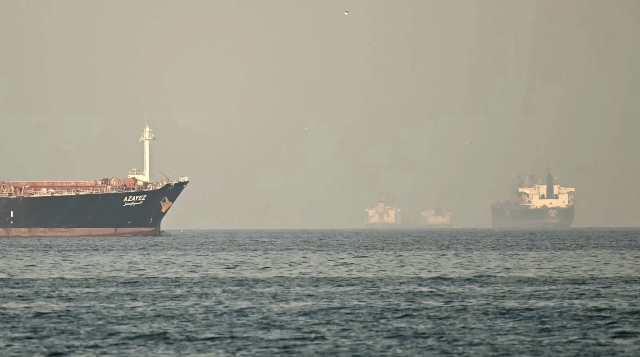 Ships in the Strait of Hormuz
The US and Iran have agreed to "stand down" following an exchange of strikes over the past few days, media reports cite a US official as saying.
It comes after several attacks in and around the Strait of Hormuz, with both nations accusing each other of violating their ceasefire.
The US official told the BBC's US partner CBS News on Sunday that vessels would be able to move through the Gulf waterway "freely", and that talks on a deal to permanently end the war would continue.
On Monday, Deputy Iranian Foreign Minister Kazem Gharibabadi denied that there were plans for technical talks this week. But US President Donald Trump said a meeting would be held in Qatar's capital at Iran's request.
"IRAN HAS REQUESTED A MEETING. IT WILL TAKE PLACE TOMORROW IN DOHA!" he wrote on Truth Social, without giving any details.
On 17 June, the US and Iran signed a 14-point Memorandum of Understanding (MoU), which included an "immediate and permanent termination of military operations on all fronts".
As part of the MoU, Iran agreed to use its "best efforts for the safe passage of commercial vessels with no charge for 60 days".
But the ceasefire agreed less than two weeks ago has been under threat in recent days because of renewed attacks by both sides.
Strikes resumed on Thursday after an Iranian projectile hit a cargo ship in the Strait of Hormuz.
Over the weekend, the US retaliated with a series of strikes on Iran, hitting multiple targets in what US Central Command (Centcom) called a direct response to the "continued aggression" against commercial shipping.
On Saturday, Iran responded with strikes on US bases in Kuwait and Bahrain. The US has said none of these attacks reached their targets, and there were no casualties or damage.
The Strait of Hormuz is a key waterway for oil and gas shipments, and was effectively closed by Tehran after the US and Israel launched attacks on Iran at the end of February.
On Friday, the US also mediated the signing of a framework agreement between Israel and Lebanon aimed at paving the way to a lasting peace.
Due to ongoing fighting between Israeli forces and the Iranian-backed armed group Hezbollah in southern Lebanon, that ceasefire also looked shaky.
The leader of Hezbollah rejected the agreement and accused the Lebanese government of undermining Lebanon's sovereignty.
On Sunday, two days after the agreement was signed, the Israeli army said it had struck a 200m-long tunnel used by Hezbollah in southern Lebanon, which it said contained hundreds of weapons.
The US was informed ahead of the attack, according to a statement from Israeli Prime Minister Benjamin Netanyahu and Defence Minister Israel Katz.
Tehran says hostilities in Lebanon must stop for a wider ceasefire deal to stick.
Source: bbc.com


Trending News

Cabinet begins final review of government's position on constitutional reforms
13:04
'We can build a maintenance culture' – VP Opoku-Agyemang calls for greater role for technicians
18:38
Anfoega Wadamaxe residents plead for completion of abandoned road, electricity supply
12:05
Pig Farm Assembly Member calls for law to make national cleanup monthly and compulsory
20:31
Nkokɔ Nkitinkiti: Minister finds possible silver lining as beneficiaries flout rules by eating breeding stock
16:19
Kwame Agbodza warns contractors: Submit work plans or risk payment cuts
05:43
Woman, 61, gives birth through Mary Lucy Hospital's Stem Cell-Enhanced IVF procedure
19:17
Community leaders engage Korle Woko residents over concerns about alleged prostitution
12:42
Don’t intimidate citizens; explain your actions – VP tells security agencies
18:44
Okatakyie Afrifa Mensah's team confirms police custody, alleges 4 associates sustained gunshot injuries
04:04
