

Govt resets Ghana’s fisheries sector with new ‘blue economy’ agenda
News
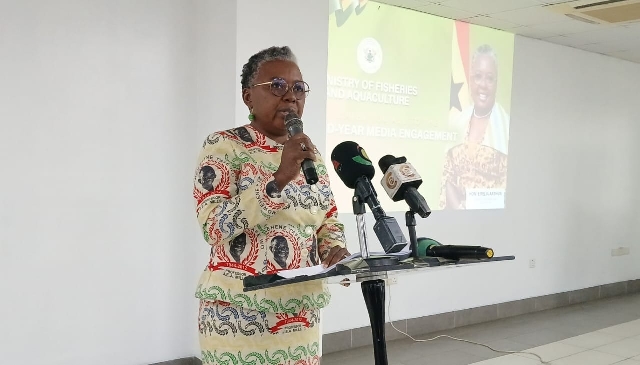 Emelia Arthur, Minister for Fisheries and Aquaculture Development
The Ministry of Fisheries and Aquaculture has unveiled a comprehensive reset of Ghana’s fisheries sector, anchored on a new law, stronger enforcement, expanded aquaculture, and a national “Blue Economy” strategy.
At a mid-year media engagement in Accra, the Minister for Fisheries and Aquaculture Development, Emelia Arthur, said the reforms are aimed at restoring sustainability, creating jobs, improving service delivery, and securing the livelihoods of more than 3 million Ghanaians who depend directly or indirectly on fisheries.
She noted that when government assumed office in January 2025, the sector faced declining fish stocks, high fish imports, persistent Illegal, Unreported and Unregulated (IUU) fishing, and weak governance.
The “reset” is being driven by five pillars:
1. The passage of the Fisheries and Aquaculture Act, 2025 (Act 1146) was described as a landmark reform.
The new law replaces the 2002 Act and strengthens the Fisheries Commission, creates a Fisheries Enforcement Unit and Development Fund, establishes aquaculture development zones, toughens measures against IUU fishing, and extends the Inshore Exclusion Zone to 12 nautical miles to protect small-scale fishers.
The Ghana Fisheries Institute at Anomabo, now about 70% complete, is also being positioned as the country’s premier centre for fisheries training and research.
Government has also inaugurated the Ghana Fisheries Transparency Initiative multi-stakeholder group.
2. In April 2026, Cabinet approved Ghana’s first Marine Protected Area—the Greater Cape Three Points MPA.
Covering 704 sq km from Ampatano to Domunli, it benefits 21 coastal communities and is expected to help restore stocks, protect biodiversity, and build climate resilience.
She also implemented the 2025 closed season for industrial, semi-industrial and inshore vessels while exempting small-scale fishers.
Enforcement capacity has been boosted with logistics, vehicles, and electronic monitoring systems.
Officials warned that illegal mining pollution near Cape Three Points “threatens our conservation investments”.
3. Major reforms to premix fuel distribution have improved supply and accountability.
Through direct distribution, more BDCs, and automation, 22.41 million litres were supplied between January and June 2026—a 58% increase over 2025.
Audits of Community Development Funds covering GH¢4.98 million across 42 districts identified weaknesses.
The Ministry has since rolled out financial management training for Landing Beach Committees.
Out of 157 planned automated premix stations, 138 have been completed and 74 are operational.
A pilot of LPG-powered outboard motors is also being scaled up.
4. With national demand at about 1.2 million metric tonnes, the government is prioritizing aquaculture.
The Komfueku Aquaculture Project is converting abandoned pits into commercial fish farms.
A new community-based commercial aquaculture programme will support cooperatives with technical help and market access.
For the first time, Ghana has issued a provisional licence for offshore mariculture, targeting high-value species like cobia, red snapper and pompano to attract investment and reduce pressure on wild stocks.
5. Government has finalized a Blue Economy Strategy and Policy framework with a bill being prepared for Cabinet.
The plan seeks to turn Ghana’s 550km coastline and inland waters including Lake Volta into engines for jobs, investment, tourism, and renewable energy.
“Fish remains the single most important source of animal protein for Ghanaians, contributing approximately 60 percent of our animal protein intake. The average Ghanaian consumes about 25kg annually,” the Ministry stated.
She emphasised that the reforms are about more than the fish—they are about food security, jobs, and national assets.
Priorities for the rest of 2026 include full implementation of Act 1146, intensified enforcement, scientific fisheries management, infrastructure upgrades, and mobilizing investment for the Blue Economy.
“Ghana’s fisheries sector is changing. We are replacing depletion with sustainability, uncertainty with planning, and dependence with innovation,” the Ministry said.
She called on fishers, processors, investors, traditional authorities, development partners, and the media to partner in protecting the resource “for generations yet unborn”.


Trending News

'Your money is safe under Mahama's gov't' - Ato Forson assures Ghanaians
19:51
Otumfuo commends IGP, Ashanti Regional Police and Special Operations Team for strengthening security
12:02
Wontumi is not a Galamsey 'kingpin' - Kofi Tonto
14:01
Chairman Wontumi campaign declares unwavering support after court judgment
10:20
Western Region Police impound 700 vehicles over illegal sirens and beacon lights
23:34
Police probe alleged assault on Graphic journalist by officers at Teshie
10:49
Ghana’s economy ranked 8th largest in Africa - Ato Forson discloses
19:42
Exim Bank Fraud Case: Attorney General rejects Chairman Wontumi's plea bargain deal
11:52
Asawase Drug Bust: Two arrested as Police recover 100 suspected parcels of narcotic drugs
11:18
Ashanti Caucus NPP MPs back Chairman Wontumi after High Court judgment
10:13
