

Eric Opoku unevils bold reforms to attract private investment into Ghana's rice value chain
News
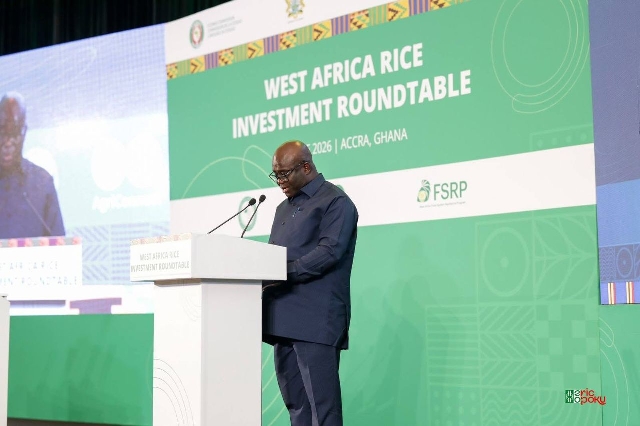 Eric Opoku
The Minister for Food and Agriculture, Hon. Eric Opoku, has outlined a comprehensive package of policy and infrastructure reforms aimed at transforming Ghana’s rice sector into an attractive destination for private investment and accelerating the country’s journey toward rice self-sufficiency.
Addressing participants at the ECOWAS Rice Investment Roundtable in Accra, the Minister stressed that while recent government initiatives, including the satellite-based spatial mapping of 100,000 hectares of rice farmland and the introduction of a producer-importer quota policy, are important, they must be supported by broader structural reforms to deliver lasting results.
According to Hon. Opoku, attracting sustainable investment into the rice value chain requires creating a predictable and investor-friendly environment that allows producers, millers, aggregators, and financiers to operate with confidence.
“The critical challenge before us is not simply introducing new interventions, but building the policy architecture that makes investment viable and sustainable,” he said.
The Minister explained that Ghana’s producer-importer quota policy is designed as a market-linkage mechanism rather than an import restriction measure. He noted that the policy will be complemented by a predictable producer pricing framework to provide certainty for investors and value-chain actors.
“This framework will enable investors to determine how much they can pay for paddy and what margins they can reasonably expect, thereby reducing uncertainty and encouraging long-term investment,” he stated.
Hon. Opoku further announced that the government is transitioning from broad-based subsidies to targeted credit arrangements backed by off-take agreements. Under this approach, the Ministry aims to have at least 25 percent of rice farmers operating under structured off-take agreements by 2028.
He explained that the move will reduce pressure on public finances while creating stronger market systems that improve access to financing for farmers and agribusinesses.
The Minister also highlighted the urgent need to modernize Ghana’s rice milling industry, revealing that the country’s current milling conversion rate of between 50 and 55 percent is resulting in annual losses estimated at between US$15 million and US$19 million.
He attributed the challenge not only to outdated technology but also to fragmented supply chains that make it difficult for investors to justify significant capital expenditure on modern equipment.
To address this, the government plans to link production clusters to licensed millers through contract-based arrangements that guarantee consistent supply volumes.
In addition, Hon. Opoku disclosed that discussions are underway with development finance institutions to establish a Rice Processing Modernization Facility that will combine grant funding with concessional loans to support investments in modern milling infrastructure.
The Ministry also intends to introduce time-bound capital grants and equipment leasing schemes to facilitate the replacement of obsolete machinery across the sector.
Beyond production and processing, the Minister identified rural infrastructure as one of the most important reforms needed to unlock investment in agriculture.
“Investment will not flow at scale into production areas where moving produce to markets remains difficult,” he emphasized.
Citing evidence that improved feeder roads can reduce post-harvest losses by up to 30 percent and increase farm-gate prices by between 4 and 8 percent, Hon. Opoku said the government is prioritizing the rehabilitation of roads connecting production zones to markets under the Feed Ghana Programme.
He noted that improving transportation networks will reduce costs, strengthen market access, and increase returns for farmers while creating a more attractive environment for private sector participation.
The Minister’s remarks formed part of discussions at the ECOWAS Rice Investment Roundtable, which seeks to mobilize public, private, and blended financing to implement national and regional rice investment action plans across West Africa and support the region’s ambition of achieving rice self-sufficiency by 2035.
His address underscored Ghana’s commitment to pursuing market-driven reforms that strengthen the entire rice value chain while positioning agriculture as a key driver of economic growth, food security, and job creation.
Source: Classfmonline.com/Cecil Mensah


Trending News

High Court sets July 3 for judgment in Chairman Wontumi illegal mining case
00:50
Minority urges Prez. Mahama government to focus on Jobs, Cost of Living
10:10
C/R: Archbishop Palmer-Buckle pays pastoral visit to Apam parish, confirms 30 young Catholics
13:56
Mahama criticises South Africa’s response to xenophobic attacks
01:27
Transport Ministry to meet GRTCC, GPRTU over proposed 20% fare increase
09:21
Accra-Cape Cost Floods: MP for Okaikwei Central wants works and Housing minister summoned
13:23
Gideon Boako flags banking sector tension
05:18
Christian Council backs Mahama’s legal review of anti-LGBTQ bill, urges patience and due process
00:47
Institutional Suppliers threaten protest over unpaid free SHS contracts
07:55
Instagram AI chatbot tricked by hackers to give access to others' accounts
15:53