

One in every three women suffer Gender-Based Violence in Ghana – FIDA
News
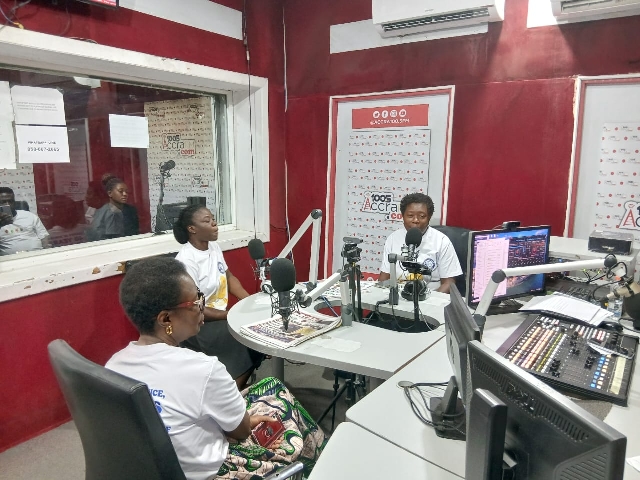 FIDA team in Accra FM studio
A discussion on Ghana Yenson show on Accra 100.5 FM has renewed attention to the prevalence of Gender-Based Violence (GBV) in Ghana, with the International Federation of Women Lawyers (FIDA) revealing that one in every three women experiences some form of abuse.
Speaking during the Ghana Yensom morning show on Thursday, host Chief Jerry Forson asked for clarity on what constitutes Gender-Based Violence.
Responding, the Acting Executive Director of FIDA, Mrs. Susan Aryeetey, explained that GBV refers to the mistreatment of both men and women, as “gender” includes both males and females.
Mr Aryeetey was joined by Noelle Appiah, Programmes Manager at FIDA and Rebecca Teiko Sarbah, the Public Relations Officer for FIDA
However, she emphasised that available data shows women are disproportionately affected.
Mrs. Aryeetey noted that many harmful cultural practices fall under Gender-Based Violence, particularly those targeted at women.
She cited widowhood rites, where widows are sometimes forced to undergo degrading rituals to prove they were not responsible for their husbands’ deaths.
According to her, such practices are clear examples of GBV because they are largely imposed on women.
She also highlighted Female Genital Mutilation (FGM), early marriage, and forced marriage as common forms of violence against girls.
In some cases, girls are taken out of school and married off before the age of 12, especially in parts of northern Ghana.
Mrs. Aryeetey explained that in some communities, when one girl is removed from school for marriage, another sibling may replace her, masking the problem harder to detect.
“Anything that is done mostly to women and not to men, especially when it causes harm or limits their opportunities, qualifies as Gender-Based Violence,” she said, adding that while men also experience certain forms of GBV, women remain the most affected group.
On the legal framework, Mrs. Aryeetey acknowledged that Ghana has strong laws addressing domestic and Gender-Based Violence.
However, she stressed that the major challenge lies in implementation.
She pointed out gaps in support systems, particularly the lack of shelters for victims.
Using the recent Ofankor domestic violence incident as an example, she explained that victims are often advised to leave abusive environments, but many have nowhere safe to go.
“If there were functional shelters in every region, many lives could be saved,” she noted.
She further explained that financial constraints prevent many victims from reporting cases to the police, and even when reports are made, some cases are not pursued for prosecution.
As a result, numerous incidents of Gender-Based Violence go unreported or unresolved.
Mrs. Ayietey concluded by calling for stronger institutional support, improved access to shelters, and better enforcement of existing laws to effectively address Gender-Based Violence in Ghana.
She took the opportunity to thank the African Women Development Fund, UNDP and UNFPA for the support


Trending News

One in every three women suffer Gender-Based Violence in Ghana – FIDA
15:32
Deputy Minister expresses relief over progress in resolving Bawku conflict
12:02
Supreme Court halts Kpandai rerun pending determination of Nyindam’s application
12:15
Global InfoAnalytics poll gives NPP’s Nyindam narrow edge ahead of Kpandai rerun
07:20
Daddy Lumba’s funeral in limbo as court grants injunction to maternal family
12:19
Ghana would be living its best life without Minority in Parliament — Adama Suleman fires
12:06
NPP government left contractors unpaid for 8 years in Upper Denkyira East – MCE
13:22
Prez. Mahama sends Ghanaian troops to aid Jamaica’s recovery
11:48
President Mahama hosts farewell meeting for outgoing Palestinian Ambassador
12:10
Unemployed Environmental Health officers to demonstrate today Dec.15 over years of joblessness
07:10
